The Silent Tongue: Why Icons Speak Louder Than Words
Exploring the concept of "Beeldtaal" (Visual Language). Why the brain processes icons 60,000x faster than text and how to leverage this for better UX.
Icora Team
Design Theory

There is a profound concept in Dutch design philosophy known as "Beeldtaal" - literally translated as "Image Language." It posits a simple but radical idea: images are not merely decorative supplements to text; they are a distinct, autonomous form of communication with their own grammar, syntax, and vocabulary.
In the digital realm, icons are the words of this language. When we design an interface, we are essentially writing a sentence in Beeldtaal. If your icons are unclear or inconsistent, you aren't just making "bad art"-you are speaking gibberish to your user.
The Speed of Sight
The human brain is fundamentally wired for visual processing. While reading text is a learnt cognitive skill that requires distinct processing steps (recognizing shapes -> mapping to phonemes -> decoding meaning), visual recognition is primal and instantaneous.
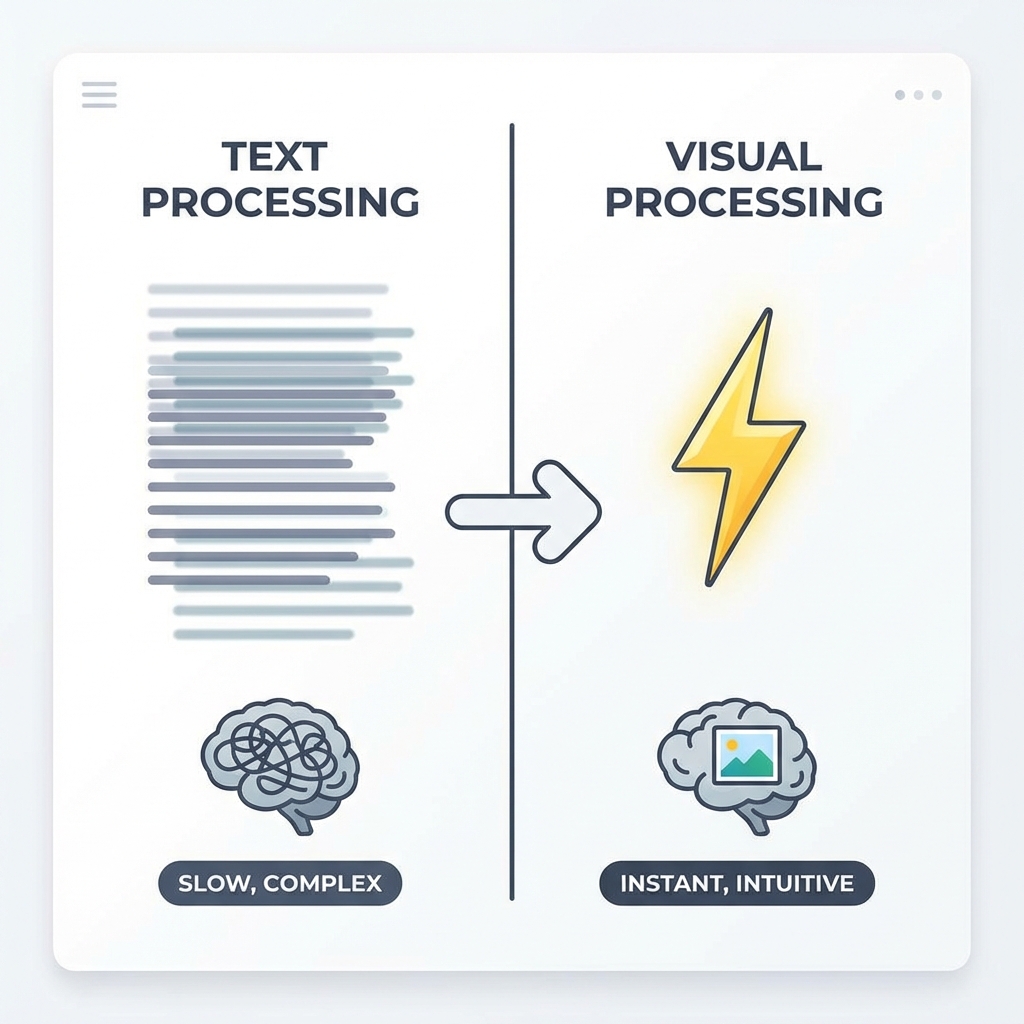
Research by 3M suggests we process visuals up to 60,000 times faster than text. When a user scans your app dashboard, they don't read "Settings" - they recognize the gear silhouette. They don't read "Home" - they perceive the house shape. This rapid-fire pattern matching is what makes a "intuitive" interface feel fast.
This ease of processing is fragile. If your "Settings" icon looks like a flower, the user's brain stumbles. It has to switch from fast "System 1" visual processing to slow "System 2" textual reading. We call this "Cognitive Friction."
Try Icora FreeUniversality: The Barrier Breaker
Text is strictly bound by linguistic borders. "Home" is "Huis" in Dutch, "Maison" in French, "家" in Japanese, and "Anw" in Arabic. To reach a global audience with text, you need massive localization efforts.
But the icon? A simple, geometric outline of a shelter? That is understood in Tokyo, New York, and Amsterdam instantly. Visual language is the closest thing humanity has to a universal tongue. By relying on established iconographic metaphors, your application becomes natively international.
Lessons from the Road
The greatest example of Beeldtaal is not on the web, but on the highway. A Stop sign is an octagon (shape) and red (color). You don't need to read the word "STOP" to know what to do. The Hazard symbol (black on yellow) triggers caution before you identify the threat. We must design our interfaces with this same primal clarity.
The Vocabulary of UI
Just like spoken language, Beeldtaal evolves. New words enter the lexicon constantly. Ten years ago, three horizontal lines meant nothing. Today, the "Hamburger Menu" is a universally understood signifier for "navigation."
As designers, we must be careful not to invent new words where existing ones will do. While it might be tempting to design a clever new abstract shape for "Search," using a magnifying glass is simply better communication. In Beeldtaal, clarity always trumps novelty.
Found this helpful? Share it!
Ready to Create Stunning Icons?
Put these principles into practice with Icora's AI-powered icon generator, professional studio tools, and developer-ready export.
Start Creating Free